First Response Emergency Care level 3 (FREC3)

Our 5-day FREC 3 course is clinically endorsed by the Faculty of Pre-Hospital Care - RCSEd. Perfect for those entering the ambulance service, event medical sector, or close protection.

30 Hours in the classroom (5 Days), then you will have workbooks to complete.

Who Is This Course For?

  • Security personnel
  • Event medics
  • Close protection operatives
  • Police, fire, and ambulance staff
  • Individuals seeking careers in emergency and pre-hospital care

Qualsafe Registered Centre Logo with Registration Number 0906845

What you'll learn

  • Roles and Responsibilities of a First Responder
  • Emergency Services capabilities
  • Mechanism of injury and incident
  • Airway management and emergency oxygen
  • Breathing difficulties (trauma and medical)
  • Responding to changes in risk and/or threat
  • Moving and Handling: in an emergency and assisting a Clinician
  • Environmental exposure
  • Adult, child and infant BLS and AED usage
  • Operational readiness and human factors
  • Structured patient assessment
  • Life threatening bleeding control
  • Pre- Hospital trauma care
  • Pre-Hospital emergency medical care
  • Primary Triage (Ten second triage) and life saving interventions
  • Recording assessment findings
  • Immersion and submersion incidents

Requirements

  • The Test papers are in English
  • You will be required to do CPR on the floor
  • You will be required to complete the 5 day course
  • Advanced notice may be given for special requirements on test papers. ie: Large print
1.1.1 Identify the roles and responsibilities of First Responder
1.1.4 Identify need for establishing and maintaining consent
1.1.5 Identify appropriate methods to record an incident
1.1.2 Identify how to maintain professional standards and operational readiness
1.1.3 Identify factors that can affect First Responders' performances and how to address them
1.1.2 Identify how to maintain professional standards and operational readiness
1.1.3 Identify factors that can affect First Responders' performances and how to address them
1.2.6 Identify the responsibilities and capabilities of the Emergency Services and Ambulance Resources
1.2.7 Demonstrate how to call for assistance from the Emergency Services and Clinical Support
1.2.1 Assess factors that impact a scene, First Responders and patient safety
1.2.2 Perform a dynamic scene risk assessment
1.2.3 Demonstrate safe scene approach and initial scene management
1.2.4 Demonstrate Primary Triage and the use of a Triage Tool
1.2.5 Demonstrate Pre-hospital Emergency Care interventions
1.2.1 Assess factors that impact a scene, First Responders and patient safety
1.2.2 Perform a dynamic scene risk assessment
1.2.3 Demonstrate safe scene approach and initial scene management
1.2.4 Demonstrate Primary Triage and the use of a Triage Tool
1.2.5 Demonstrate Pre-hospital Emergency Care interventions
1.2.1 Assess factors that impact a scene, First Responders and patient safety
1.2.2 Perform a dynamic scene risk assessment
1.2.3 Demonstrate safe scene approach and initial scene management
1.2.4 Demonstrate Primary Triage and the use of a Triage Tool
1.2.5 Demonstrate Pre-hospital Emergency Care interventions
2.1.1 Recognise the definition of the term 'mechanism of injury'
2.1.2 Identify characteristics of trauma leading to injuries
2.1.3 Recognise the clinical importance of considering the mechanism of an injury
3.1.1 Establish the presenting complaint and it's potential cause
3.1.2 Perform a structured patient assessment
3.1.3 Obtain patient history
3.1.4 Determine the severity of a patients condition
1.1.4 Identify need for establishing and maintaining consent
1.1.6 Identify patient specific medical documents
1.3.1 Conduct a Patient Assessment using the Patient Assessment Triangle Tool
1.3.2 Communicate with Patient prior to and during assessment
1.3.3 Perform a Patient Assessment on a Patient in a life- threatening condition and a non life- threatening condition
2.3.1 Recognise life-threatening blood loss
2.3.2 Recognise the severity of blood loss
2.3.3 Demonstrate management of severe blood loss
1.4.1 Identify airway anatomy
1.4.2 Differentiate between adult and paediatric airway anatomy
1.4.2 Identify the importance of stepwise airway management and maintenance
1.4.4 Demonstrate dynamic airway assessment
1.5.1 Identify contributing factors to an airway becoming difficult to manage
1.5.8 Recognise the need for Clinical Support to provide airway management
3.4.1 Identify common causes of unconsciousness
1.5.2 Explain need to clear the airway
1.5.3 Demonstrate how to clear, manage and maintain a patients airway
1.5.4 Demonstrate how to select size and insert airway adjuncts
1.5.5 Respond to changes in patients condition to maintain airway patency
1.5.6 Differentiate between mild and severe choking
1.5.7 Administer emergency care to a patient who is choking
1.8.1 Identify the indications, containdications and cautions for administration of medical gasses
1.8.2 Identify safety considerations when storing and using medical gas cylinders
1.8.4 Monitor the effects of medical gasses
1.8.5 Identify the need to alert a Clinician to adverse reactions
1.8.6 Record the administration of medical gasses
1.8.3 Administer medical gasses to a patient at the appropriate dose, using the appropriate adjuncts
1.8.4 Monitor the effects of medical gasses
1.8.6 Record the administration of medical gasses
3.1.1 Establish the presenting complaint and its potential cause
3.1.2 Perform a structured patient assessment
3.1.3 Obtain a patient history
3.1.4 Determine the severity of a patients condition
3.1.1 Establish the presenting complaint and its potential cause
3.1.2 Perform a structured patient assessment
3.1.3 Obtain a patient history
3.1.4 Determine the severity of a patients condition
3.2.1 Identify major components of the respiratory system
3.2.2 Identify risk factors that could contribute to respiratory distress
3.2.3 Identify recognition features of respiratory distress
2.5.1 identify the major components of the circulatory system
3.3.1 Identify characteristics and clinical features of medical emergencies
3.3.2 Demonstrate pre-hospital emergency care for medical emergencies
3.3.3 Demonstrate safe administration of medications for an acute medical emergency
1.6.1 Identify potential cause of Cardiac Arrest and the components of the Chain of Survival
1.6.3 Justify when to commence Cardiopulmonary Resuscitation
1.7.1 Justify when to use an Automated External Defibrillator
1.7.3 Identify safety considerations when using AEDs
1.7.2 Demonstrate effective use of an Automated External Defibrillator
1.6.2 Demonstrate how to open patients airway and check for breathing
1.6.3 Demonstrate Basic Life Support for an adult on a manikin
1.6.7 Demonstrate return of spontaneous circulation procedures
1.6.8 Perform a patient handover to the next echelon of care
1.6.3 Justify when to commence cardiopulmonary resuscitation
1.7.2 Demonstrate effective use of an Automated External Defibrillator
1.7.1 Justify when to use an Automated External Defibrillator
1.7.3 Identify safety considerations when using AEDs
1.6.10 Identify modifications required during Cardiac Arrest
1.6.11 Identify when resuscitation should not be attempted
1.1.6 Identify patient specific medical documents
1.6.2 Demonstrate how to open patients airway and check for breathing
1.6.3 Justify when to commence cardiopulmonary resuscitation
1.6.4 Demonstrate Basic Life Support for a child on a manikin
1.6.8 Demonstrate return of spontaneous circulation procedures
1.6.9 Perform a patient handover to the next echelon of care
1.6.4 Demonstrate Basic Life Support for an Infant on a manikin
1.7.1 Justify when to use an Automated External Defibrillator
1.7.2 Demonstrate effective use of an Automated External Defibrillator
1.7.4 Identify basic maintenance procedures for AEDs to remain ready for use
1.7.5 Demonstrate how to address common faults on AEDs
2.1.1 Recognise the definition of the term 'mechanism of injury'
2.1.2 Identify characteristics of trauma leading to injuries
2.1.3 Recognise the clinical importance of considering the mechanism of injury
2.2.1 Identify actual and potential time-critical features of trauma
2.2.1 Identify actual and potential time - critical features of trauma
2.2.2 Perform patient assessment on patients who sustained injuries
2.2.3 Demonstrate treatment and management of patients who have sustained injuries
2.4.1 Identify clinical features of critical chest injuries
2.4.2 Perform a patient assessment to determine the presence of a chest injury
2.4.3 Demonstrate treatment and management of chest injuries
2.4.1 Identify clinical features of critical chest injuries
2.4.2 Perform a patient assessment to determine the presence of a chest injury
2.4.3 Demonstrate treatment and management of chest injuries
2.6.1 Identify recognition features of Hypovolaemic Shock
2.6.2 Assess and manage a patient with compromised circulation
2.3.1 Recognise life-threatening blood loss
2.3.2 Recognise the severity of blood loss
2.3.3 Demonstrate management of severe blood loss
2.5.2 Differentiate between types of bleeding
2.5.5 Apply wound care within scope of practice
2.5.3 Estimating external blood loss
2.5.4 Apply methods to treat external bleeding
2.5.6 Identify recognition features of wound infection
2.8.1 Classify the severity of burns and scalds
2.8.2 Identify methods to treat burns and scalds
3.3.1 Identify recognition features of medical emergencies
3.3.2 Demonstrate Pre-Hospital emergency care for medical emergencies
3.3.3 Demonstrate safe administration of medications for an acute medical emergency
3.3.1 Identify recognition features of medical emergencies
3.3.2 Demonstrate Pre-Hospital emergency care for medical emergencies
3.3.3 Demonstrate safe administration of medications for an acute medical emergency
3.3.1 Identify recognition features of medical emergencies
3.3.2 Demonstrate Pre-Hospital emergency care for medical emergencies
3.3.3 Demonstrate safe administration of medications for an acute medical emergency
3.3.1 Identify recognition features of medical emergencies
3.3.2 Demonstrate Pre-Hospital emergency care for medical emergencies
3.3.3 Demonstrate safe administration of medications for an acute medical emergency
2.1.1 Recognise the definition of the term 'mechanism of injury'
2.1.2 Identify characteristics of trauma leading to injuries
2.1.3 Recognise the clinical importance of considering the mechanism of injury
2.2.1 Identify actual and potential time-critical features of trauma
2.2.2 Perform patient assessment on patients who have sustained injuries
2.2.3 Demonstrate treatment and management of patients who have sustained injuries
2.10.1 Recognise suspected spinal and head injuries
2.10.2 Demonstrate Pre- Hospital emergency care for suspected spinal and head injuries
2.10.3 Demonstrate how to remove a safety helmet from a patient
2.10.4 Recognise suspected musculoskeletal Injuries
2.11.1 Conduct a dynamic moving and handling risk assessment
2.11.2 Demonstrate safe use of Pre-Hospital care moving and handling equipment
2.12.1 Demonstrate assisting a clinician making ready moving and handling equipement
2.12.2 Follow instructions from a clinician to move and handle patients
2.2.1 Identify actual and potential time-critical features of trauma
2.2.2 Perform patient assessment on patients who have sustained injuries
2.2.3 Demonstrate treatment and management of patients who have sustained injuries
2.11.1 Conduct a dynamic moving and handling risk assessment
2.11.2 Demonstrate safe use of Pre-Hospital care moving and handling equipment
2.12.1 Demonstrate assisting a clinician making ready moving and handling equipement
2.12.2 Follow instructions from a clinician to move and handle patients
2.9.1 Identify routes that poisons can take to enter the body
2.9.2 Recognise effects of sudden poisoning
2.9.3 Identify the management of a patient affected by sudden poisoning
3.4.1 Identify common caused of unconsiousness
3.4.2 Differentiate between causes of convulsions and seizure like episodes
3.4.3 Recognise management of patient actively convulsing
3.4.4 Demonstrate the assessment and management of an unconscious patient
1.3.5 Apply appropriate interventions based on risk or threat assessment and respond to situational or environmental changes
1.2.4 Demonstrate primary triage and the use of a triage tool
1.2.5 Demonstrate Pre- Hospital emergency care interventions
1.1.5 Identify appropriate methods to record an incident
3.1.5 Identify appropriate referral pathways
3.1.7 Make an immediate referral to the next echelon of care
3.1.6 Record assessment findings and inverventions
1.2.6 Identify the responsibilities and capabilities of the Emergency services and Ambulance Resources
1.2.7 Demonstrate how to call for assistance from the Emergency Services and Clinical Support
3.5.1 Identify how environmental factors could affect the scene safety
3.5.2 Recognise the effects of suspected environmental exposure
3.5.3 Identify how to provide emergency care for suspected environmental exposure
3.5.4 Identify characteristics and clinical features or drowning
3.6.5 Identify how to respond to immersion and submersion incidents and provide Pre-Hospital care within scope of practice

Nicole Horncastle

Trainer and Assessor

Nicole has experience in Event Medical cover and in HDU
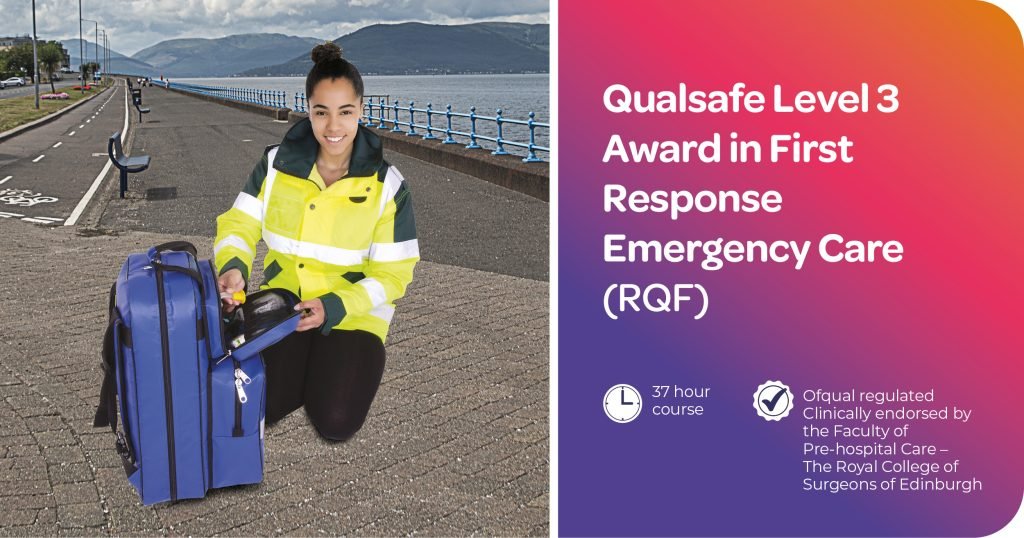
A first responder in high-visibility uniform kneeling with a professional emergency medical bag. Text: Qualsafe Level 3 Award in First Response Emergency Care (RQF) 37-hour course.

Price:

£ 525

£ 450

level:

Advanced

Duration:

5 Days

Book Now

1
Schedule
2
Details
3
Personal Info
4
Confirm

Training: First Response Emergency Care L3 (FREC3)

05/09/2026
9 AM - 5 PM
Ilford, London
Slots available 6
£450
17/10/2026
9 AM - 5 PM
Ilford, London
Slots available 6
£450
09/01/2027
9 AM - 5 PM
Ilford, London
Slots available 6
£450

-

Date & Time
-
Location
-
Trainer
-
Price
-
Available Slots
-

Fill The Personal Details

🇬🇧 +44
🇬🇧 United Kingdom +44
🇺🇸 United States +1
🇮🇳 India +91
🇦🇺 Australia +61
🇯🇵 Japan +81
🇨🇳 China +86
🇫🇷 France +33
🇩🇪 Germany +49
🇮🇹 Italy +39
🇪🇸 Spain +34
🇷🇺 Russia +7
🇧🇷 Brazil +55
🇿🇦 South Africa +27
🇰🇷 South Korea +82
🇲🇽 Mexico +52
🇳🇱 Netherlands +31
🇸🇪 Sweden +46
🇨🇭 Switzerland +41
🇧🇪 Belgium +32
🇵🇱 Poland +48
🇵🇹 Portugal +351
🇬🇷 Greece +30
🇪🇬 Egypt +20
🇦🇪 United Arab Emirates +971
🇸🇦 Saudi Arabia +966
🇸🇬 Singapore +65
🇲🇾 Malaysia +60
🇹🇭 Thailand +66
🇮🇩 Indonesia +62
🇵🇭 Philippines +63
🇳🇿 New Zealand +64
🇮🇪 Ireland +353
🇫🇮 Finland +358
🇳🇴 Norway +47
🇩🇰 Denmark +45
🇦🇹 Austria +43
🇹🇷 Turkey +90
🇳🇬 Nigeria +234
🇰🇪 Kenya +254
🇵🇰 Pakistan +92
🇧🇩 Bangladesh +880
Training service $0.00
Date
Total price $0.00
Payment method

What event organisers and trainees say about us